I read the Iliad in three days. The reading launched me into a fever dream, where instead of binge-watching Netflix, I lost myself in the familiar and unfamiliar world of Homer. I read while lying in bed, while riding in cars, while sitting in restaurants. Though there were parts of the story I knew, the Fagles translation was a wholly new landscape of sound and layering of ideas that I’d only glimpsed. The book-length poem that asks a reader to sit with an entire world on nearly every page teeming with the dead, the men they were on and off the battlefield, and the homes that war would prevent them from returning. The book became my companion. I didn’t read while sleeping but read while walking nearly 30,000 steps one Sunday afternoon. I read instead of eating, instead of sleeping. When Priam knelt beside the man who’d killed his son in combat, and kissed his hands, and begged for his departed son’s body, I wept.
Only now, a week after the deluge, do I understand what has felt a little off. It’s almost as if I were staring off into the distance at a giant windmill. Later, close enough to see the sheer heft and length of one of those slow-winding blades, I wonder if it were truly what I’d witnessed just minutes earlier. All of which is to say, I found myself incapable of not talking about the Iliad, wanting people to understand what it felt like to see the battlefields of Troy in my head while staring at coffee shops and bookstores and a community college in my town. Again, in a way different than ever before, I realized what a Freedom Library does.
When I met the Portuguese writer Rui Couceiro, all I knew of Portugal came out of the Freedom Library. I knew the poetry of Fernando Pessoa, the novels of Saramango. I knew a student once who memorized a beautiful Portuguese poem and read it to our class. I’d not heard of Babell, the International Festival where I’d be invited to walk around Porto as a friend of the city. I watched a thousand people line up for Margaret Atwood one night and witnessed thousands in a sold-out space listen to Salman Rushdie in conversation. The price of admission was a book, often purchased from the local bookstore with its own righteous lines of hundreds waiting to get into the most beautiful bookstore I’ve ever seen.
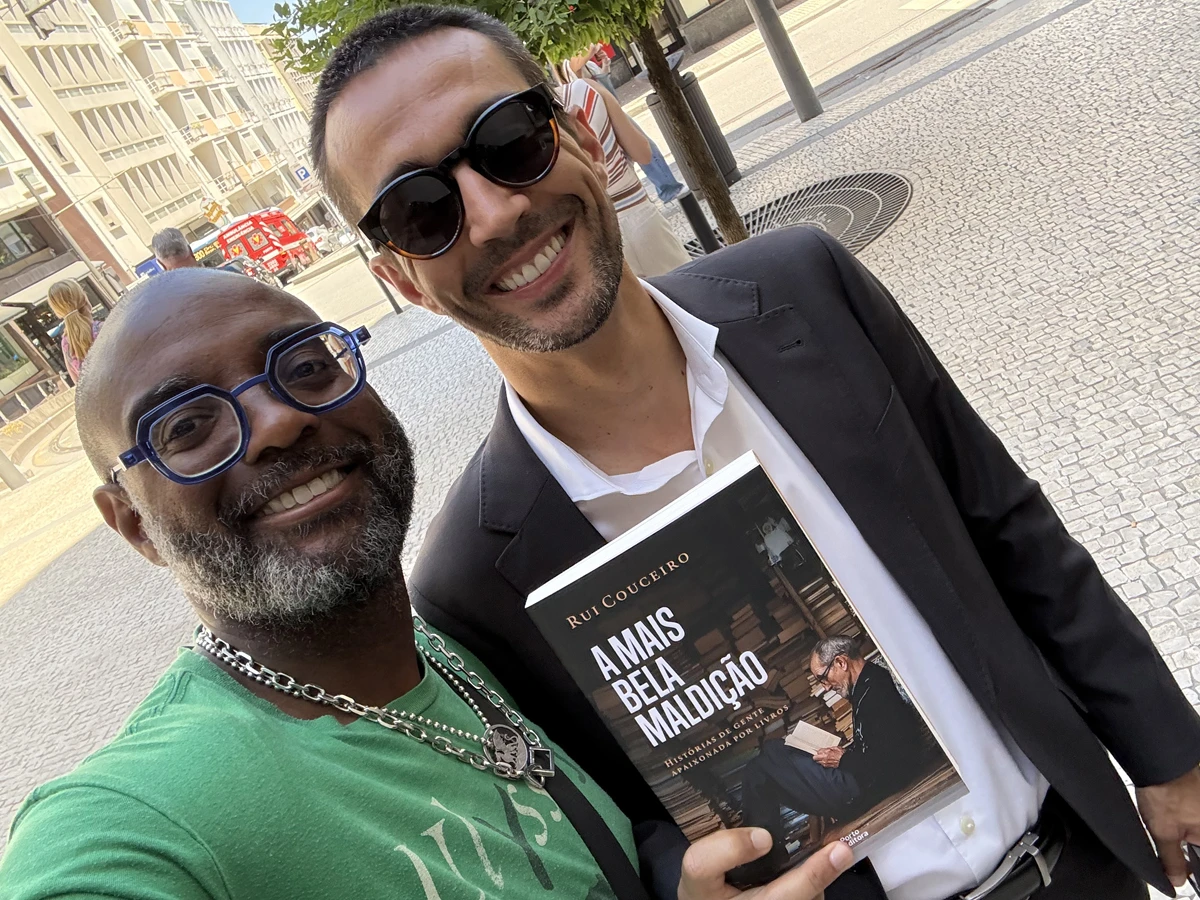
Rui’s book, A Mais Bela Maldição, was recently published in Portuguese. The back of the book challenges my scant Portuguese, but I know the title translates to “The Most Beautiful Curse” and reminds me of Saramango, or something that he or Márquez might have written about my life: a teenager finds himself in prison and discovers that his only superpower is to believe what he reads in books more than the distortions of the world around him. The beautiful curse becomes quixotic in a way. From the hundred-year-old baroness from Tuscany, to the fisherman in Povoa de Varzim, to a Bogota garbage truck driver, and a host of others, including me, become the protagonists of Rui’s book. The lot of us inventing ways to remember each other and the world that the promise of a good book might just be our only reliable transportation to the past, the future, and our own souls.
In November 2024, Service95, a partner with Rui and his team on the Babelll festival, did a story on Freedom Reads’ Inside Literary Prize. Back then, I didn’t fully understand the force that Dua Lipa was becoming in the literary world. I know now. Visiting the Manifesto Library, a collection of 100 banned books that lives in one of the most beautiful libraries in the world, reminded me that increasing access is the most legitimate response to censorship. I stared at the titles around me, some in languages I knew, many in languages I didn’t. I realized that my life was constructed page by page from those books.
I’ve been in Portugal now for a day longer than it took me to read the Iliad, and the only thing I regret is not stealing a few minutes to walk around Lisbon with my copy of Baltasar and Blimunda. But today I shall, and I shall think about the Freedom Library, and how this week I was reminded of the first and only time a book cart came my way while inside. I was at the County jail and would reach for Trevanian’s Shibumi, a book tattered and wrapped in duct tape. For a week, that’s how I survived. I imagine the Freedom Library is our nod to survival. It’s the place where tomorrow, someone who imagined their world was over might find the book that will remind them of what’s possible. And maybe that reminder will have them talking to a stranger, just as I hope this reminder encourages you to tell your friends and family about Freedom Reads, and for you and them to donate to this work if it would please you.