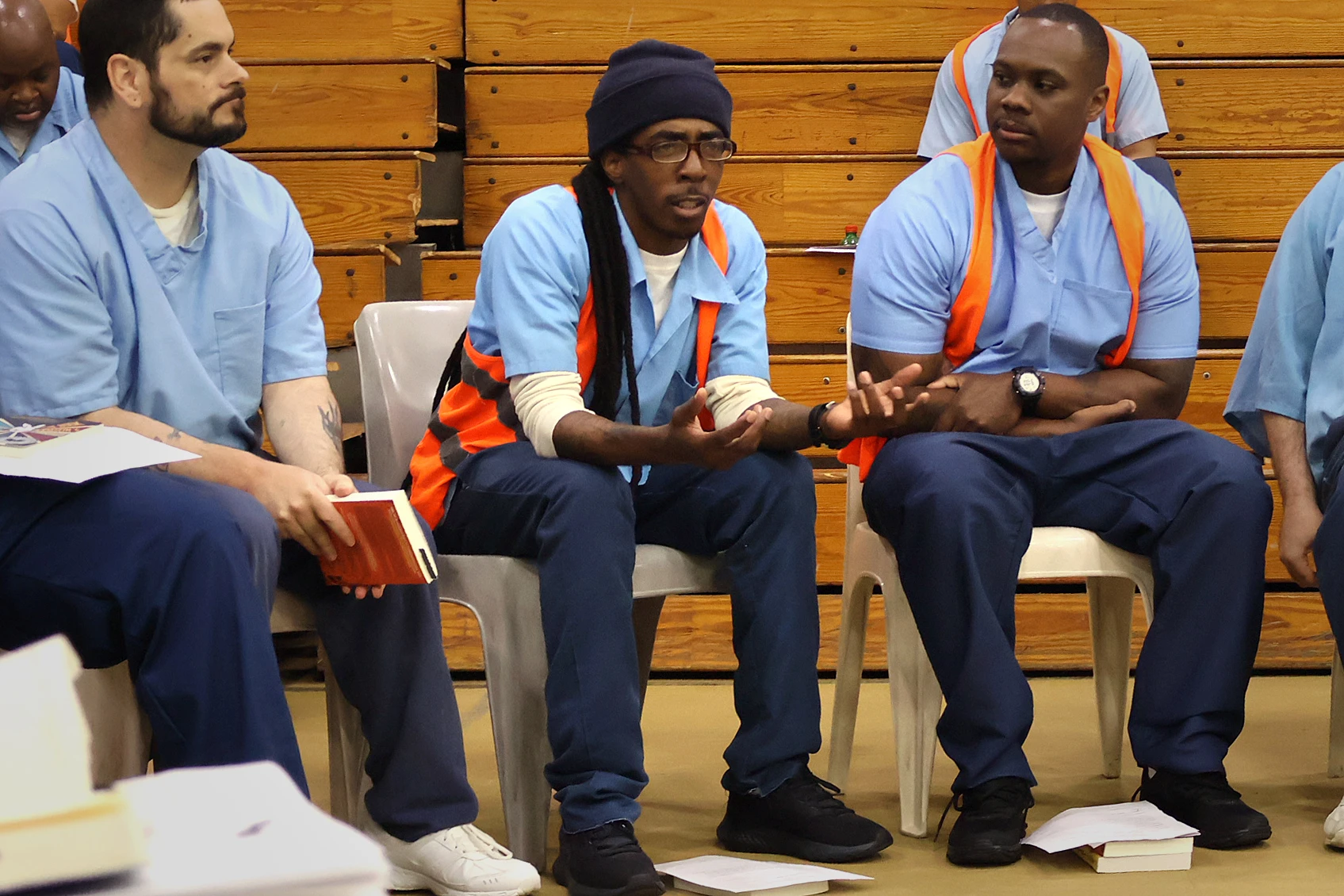
He looked at me and said, “Thank you. Thank you for looking me in the eyes. No one looks me in the eyes. Thank you for giving me the opportunity to connect with the outside world.” This is how Dy’shawn, Inside Literary Prize judge at Shawnee Correctional Center, shared his appreciation for the opportunity to participate in the only US literary competition judged exclusively by incarcerated readers. This is how he shared his appreciation for the opportunity to simply be seen.
Born from a collaboration between Freedom Reads, the National Book Foundation, the Center for Justice Innovation, and Lori Feathers, co-owner of Interabang Books, the Inside Literary Prize puts the power of literary judgment in the hands of incarcerated readers — centering the voices of people in a system built to render them invisible.
I was lucky enough to attend the first stop of the 2026 Inside Literary Prize six-state tour in Illinois. But being there, I understood that what I felt as luck was really something else — privilege. The prison system is defined by the restriction of access: who gets in, who gets out, who gets to speak, who gets to be heard. And yet there I was, walking freely through a space designed to limit movement, sitting down, sharing stories and talking openly about books with people the world doesn't get to hear from.
The trip was 4 days long, but in moments that moved me, seemed infinitely longer. I’ve worked for Freedom Reads only about 8 months now, but in that short time, I’ve had some of the most meaningful experiences of my entire career.
Our team traveled roughly 1100 miles from the Freedom Reads headquarters in Hamden, CT to Logan Correctional Center, then to Shawnee Correctional Center, both in rural Illinois. There, we talked, laughed, and sometimes cried in community with over 100 men and women. And for a moment, as I listened to some of the most beautifully intellectual reflections and the deepest sense of gratitude I may have ever experienced, it felt like we were all seeing each other exactly as we hoped to be seen.
On this trip, I recognized how the power of connection is so deeply transformative that my heart breaks at the places it doesn’t exist. In a system where the simple act of looking into someone’s eyes can be a threat, the act of being seen can feel like a gift.
Nearly every day we talk about how fast time flies. About how one minute our kids are in kindergarten, the next they’re graduating from college. It flies when you’re having fun, and when you’re not. But what I learned that week is just how much doing can be done in the time that flies.
The hours between prisons were not empty. They were tornado warnings and route diversions, sideways rain soaking through my shoes, barren roads stretching endlessly through flat land with only a few farms and even fewer dwellings. Ten hours in airports. Three hotels. Twelve hours in a car. All of it counting down toward something I didn't yet have words for.
The hours also held this: time with the authors whose words I’ve continued to carry with me. It was Nana Kwame Adjei-Brenyah, 2025 Inside Literary Prize winner, who said the thing I keep returning to: “it’s not that simple” — on how we use the little we know about a person to judge them entirely. It’s not that simple. It never is.
I've been home for a few weeks now, back with my family, back in my own life. And yet something shifted on that trip that I'm still sorting through — the way 4 days can hold so much, and leave you feeling like you've been gone for months.
We count time and assign it a number. But most of what happens inside it — the gratitude of a man asking only to be seen, the rain soaking through your shoes, the words that rearrange something in you — is truly immeasurable.
I made it home. For Dy’shawn though, the count continues.